
There’s a new AI tool every week, and a new expert telling you it’s the one that finally changes everything. Most agency owners are stuck in shiny object syndrome – one purchase away from the breakthrough that never comes. The tool was never the problem. Your operating system is.
This post covers why the next AI tool won’t move the needle, how AI amplifies your operating system for better or worse, what an agency’s operating system actually is across the eight STANDOUT levers, why readiness has to come before tools rather than after, and how to tell whether your systems are ready to be amplified.
Shiny Object Syndrome: Why the Next Tool Won't Help
Every week brings new software, a new automation, a new implementation someone wants to sell you as the thing that finally transforms your agency. Most owners feel the pull of it – the sense that the right tool is out there and they are one purchase away from the breakthrough. Most of it is noise. Not because the tools are bad, many are genuinely impressive, but because of a misunderstanding about what AI actually does.
AI does not add capability out of nothing. It takes a process that already exists and runs it faster. If the process underneath is sound, you get speed and leverage. If it is broken, you get broken output, faster. The tool is just an amplifier looking for something to amplify. I have seen a 12-person agency buy three different AI writing tools in a year and abandon each within weeks – the tools were never the issue, they simply had no shared definition of what a good first draft looked like, so every tool produced something different and nobody trusted any of it. Chasing the next tool without fixing what it plugs into is how agencies end up with a drawer full of subscriptions and nothing to show for them. And the pull is psychological, not rational. A new tool feels like progress, like you are finally doing something about AI, when often it is the most sophisticated way to avoid the harder work of fixing how you actually operate. In the AI era that habit is more expensive than ever, because the tools are now powerful enough to scale your weaknesses as efficiently as your strengths.
“AI amplifies your operating system – strong systems become leverage, weak systems become faster mess.”
AI Amplifies Your Operating System, For Better or Worse
Here is the principle that should drive every AI decision you make: AI amplifies your operating system. Strong systems plus AI produce real leverage. Weak systems plus AI produce faster mess. The technology itself is neutral – it magnifies whatever it is pointed at, and it does so without judgement.
Across the audits I have run, this plays out the same way every time. An agency with a clear, documented process for first drafts adds AI and genuinely doubles its throughput, because there is a strong system for the tool to accelerate. An agency where every person approaches the same task differently adds the identical tool and simply produces inconsistent work more quickly – and now has more output to check and correct. Same tool. Different operating system. One compounded an advantage, the other scaled a problem. My background is in psychology, and this is the part that gets missed: most AI failures inside agencies are not technical, they are structural. The model works fine. The system it is amplifying was never ready. There is an uncomfortable implication here, too. AI makes your real maturity visible. You can hide a weak process while everything is manual and slow. Speed it up tenfold and the cracks show immediately – in inconsistent output, in rework, in clients noticing. AI does not break your agency. It reveals where it was already broken.
Your Operating System Is the Eight STANDOUT Levers
When I say operating system, I mean the underlying machine of your agency – the connected systems that decide how work gets won, made, priced and delivered. It is not your tools. It is the logic and process your tools sit on top of. I assess it across eight levers, the STANDOUT framework, and each one is a place where AI either creates leverage or exposes a gap.
The eight levers are Sales (pipeline, qualification, proposals), Team (capability and AI literacy), Ambition (strategy and direction), Numbers (reporting, margin and data), Development (service design and IP), Operations (delivery workflow and automation), Uniqueness (positioning and differentiation), and Technology (your stack and governance). Most agencies are genuinely strong on some of these and quietly weak on others – and the weak ones are usually the ones nobody wants to look at. AI does not care which is which. Point it at a strong lever, like a well-run delivery workflow, and you compound a real advantage. Point it at a weak one, like undocumented pricing or ungoverned tool use, and you scale a problem you had not fully admitted to. This is why a single tool rarely works across a whole agency: it lands on eight different levels of readiness at the same time, and the result is only ever as good as the lever it touched. Looking at all eight together is what stops you over-investing in the lever you already enjoy and ignoring the one quietly costing you margin. Strength in Sales means very little if Operations cannot deliver what you sell at a profit.
Readiness Comes Before Tools, Not After
The instinct is to buy the tool and expect it to create order. It works the other way round – order has to exist first for the tool to have something to amplify. The moment you try to embed AI seriously, it forces questions most agencies have spent years avoiding: where does this process actually start and end, who owns the decision, what does good look like, and is the data even being tracked?
That clarity is the real work, and it has to come first. You cannot automate a process you cannot describe. You cannot govern AI use if you do not know what your team is already doing with it. Readiness is not a tax you pay before the interesting part – it is the part that decides whether anything you add afterwards pays back. I have watched an agency spend more time choosing a tool than defining the process it was meant to run, then wonder why adoption stalled within a month. Clarity gets forced whether you like it or not. The only choice is whether you do that thinking deliberately, up front, or discover the gaps the expensive way after you have rolled a tool out to the whole team. The agencies that win with AI are not the ones with the most tools or the earliest access. They are the ones whose operating system was coherent enough to amplify in the first place. Fix the system, then amplify it – never the other way round. AI executes; you still have to decide what is worth executing.
The Bottom Line
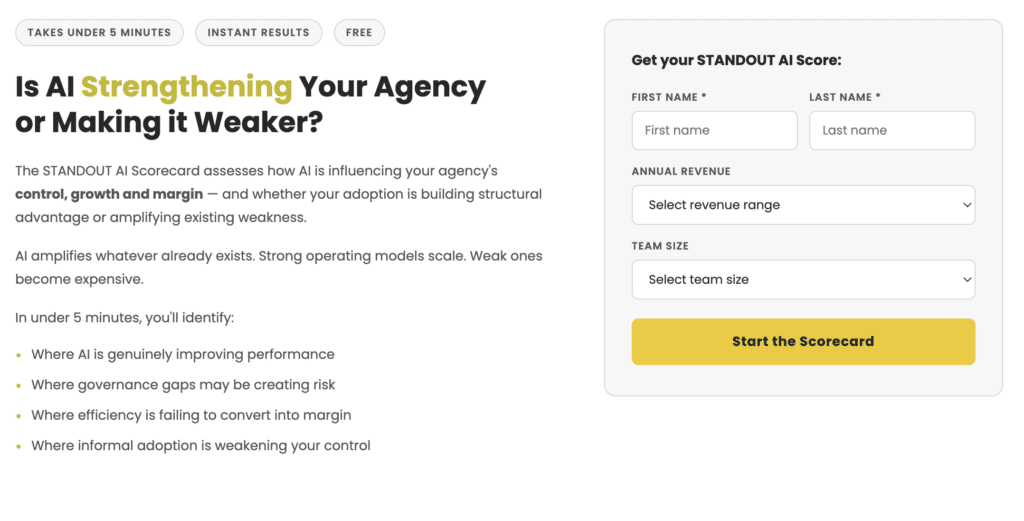
So before you buy the next tool, the question worth sitting with is simpler and less comfortable: is my operating system actually ready to be amplified, and across which of the eight levers is it strong or exposed? Standstill agencies keep buying tools and amplifying the mess underneath them, mistaking motion for progress. STANDOUT agencies fix the system first, then point AI at something genuinely worth scaling. The difference rarely comes down to budget or access – it comes down to whether the operating system was ready. If you want a fast, honest read on where yours stands across all eight levers, that is exactly what I built the STANDOUT AI Scorecard to show you: https://weareagentsofchange.com/standout-ai-scorecard/
Frequently Asked Questions
What is AI shiny object syndrome?
It is the habit of chasing new AI tools and implementations in the hope each one will transform the business, without fixing the underlying systems they plug into. The tools change constantly; the operating system underneath is what actually determines results. It feels like progress, but it is often a way of avoiding the harder structural work.
Why don’t new AI tools improve agency performance?
Because AI does not add capability from nothing – it amplifies an existing process. If that process is strong, AI creates leverage; if it is weak, AI just produces poor output faster and creates more to check. The tool is identical either way. The system underneath decides the outcome.
What does AI readiness mean for an agency?
It means your underlying systems – across sales, delivery, numbers, governance and the rest – are clear and consistent enough that AI amplifies them productively rather than scaling their flaws. Readiness is about the operating system, not the tools. An agency can be ready on some levers and badly exposed on others.
How do I know if my agency is ready for AI?
Look at how consistent and documented your core processes are, whether decisions and ownership are clear, and whether your data is actually tracked. A structured diagnostic like the STANDOUT AI Scorecard maps readiness across all eight levers, so you can see exactly where AI would create leverage and where it would expose a gap.

