
Every business name is a statement. Some are aspirational. Some are descriptive. Some are clever without being meaningful. This one is something else. Agents of Change isn’t a tagline or a brand concept – it’s a precise description of what we’re trying to do, who we’re trying to do it with, and why this particular business exists at this particular moment.
This post tells that story. Not the credentials version – you can find that on the About page. The real story: what we each kept seeing, where those observations collided, and why the name was the only one that felt right.
The Pattern Gareth Kept Seeing
After selling my 50% equity in my agency, I started working with other agency founders. And within a few months, a pattern was impossible to ignore. Talented people. Strong client relationships. Real craft. But businesses that were running their owners rather than the other way around. Founders still at the centre of every decision, margins thinner than they needed to be, and a model that had never really been designed – it had just accumulated, project by project, hire by hire, over years.
The thing that struck me most wasn’t the problems. It was how consistent they were. Almost every agency owner I sat with already knew what needed to change. They weren’t short of insight. They were short of the conditions that make change actually happen – the clarity, the external perspective, the willingness to prioritise building over doing, even for a short time. What they needed wasn’t someone to tell them what was wrong. They needed someone willing to sit with them while they fixed it. To challenge the assumptions that had slowly become permanent features of a business that was supposed to be a vehicle, not a trap. That’s what the advisory work became. And it was useful – genuinely useful. But I could see something else coming that was going to make the whole conversation more urgent.
“Most advisors can help agencies grow or help them adopt AI. Very few can do both, and do it in a way that actually fits how agencies work.”
The Problem Callum Kept Seeing
Callum came at this from a completely different direction. His background is in psychology – specifically how people think, make decisions, and respond to change. While he was studying that, he became absorbed in AI. Not as a technology story, but as a human one. Because the question everyone was glossing over wasn’t whether AI tools worked. It was whether people would actually change how they worked to use them. And that is, at its core, a psychology question.
What he kept seeing – as AI accelerated and agencies started feeling the pressure to respond – was implementation done badly. Tools adopted without strategy. Workflows bolted on rather than redesigned. Teams told to use new systems without being brought along on why. The result was what he started calling AI theatre: the appearance of innovation, none of the commercial benefit. The missing piece wasn’t better tools. It was a human-centred approach to adoption – one that understood resistance, worked with how people actually think, and connected technology to the specific commercial outcomes an agency needed to improve.
The Gap Neither of Us Could Ignore
Here’s where the two observations met. Agencies were facing a moment that required two things at once. Strategic clarity – about positioning, model, pricing, founder dependency, all the structural issues that determine whether a business grows or stalls. And practical AI capability – the ability to actually embed new ways of working into how the agency operates, in a way that sticks. The help available was consistently strong on one and weak on the other.
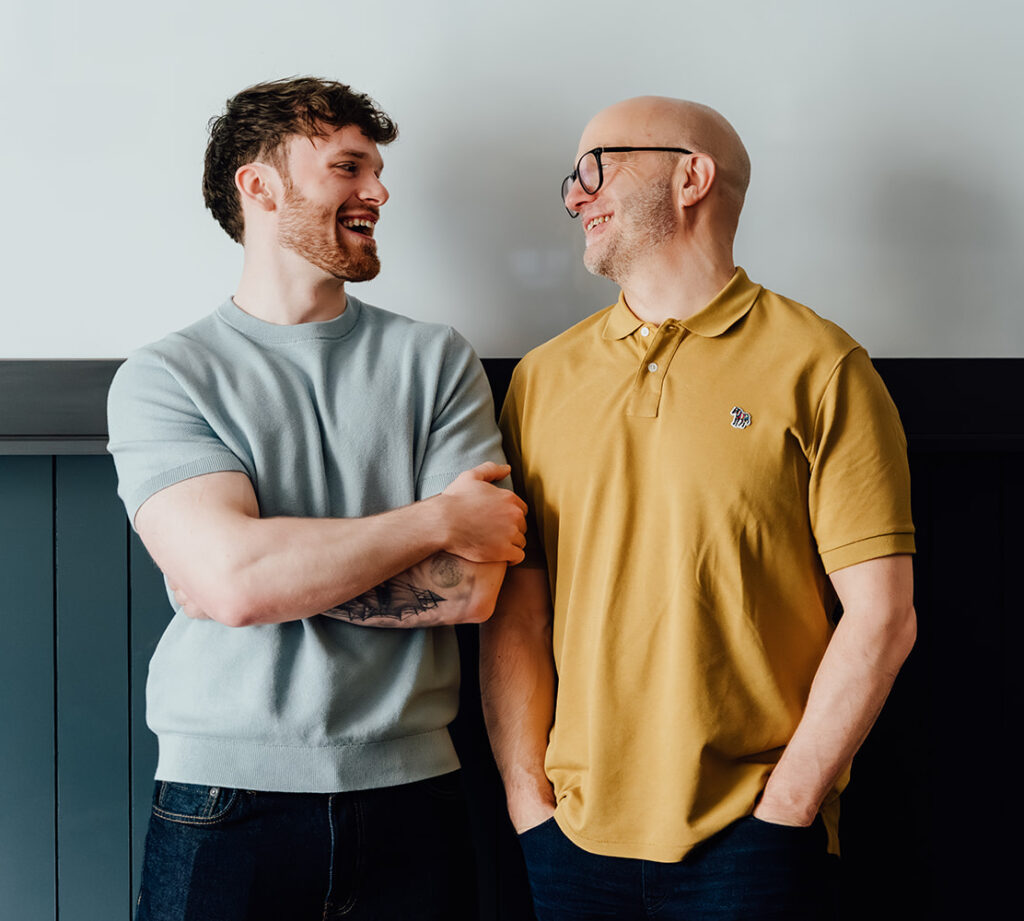
Traditional agency advisors had the strategic experience but weren’t equipped to navigate AI adoption practically. AI consultants and technology providers had the tools, but they were often solving problems they’d never lived inside. Neither combination produced what agencies actually needed. The pairing of a former agency owner who has felt every pressure an agency founder faces, and a psychologist who understands how people and machines think – that’s not a combination we engineered for positioning purposes. It’s what you get when a father who spent thirty years building and selling an agency sits down with a son who spent his degree understanding human behaviour and his early career building deep expertise in AI. Two very different journeys that produced exactly the pairing the market was missing.
Why We Landed on This Name
When we were working out what to call the business, we kept asking ourselves the same question: what is the single thing that separates the agency owners who break through from the ones who stay stuck? It isn’t sector knowledge. It isn’t service mix or marketing or even experience. It’s disposition – a specific kind of restlessness. A refusal to accept the current version of things as the final version. A willingness to do the uncertain, uncomfortable, occasionally lonely work of building something better, even when the pressure of delivery makes it far easier to keep doing what you’ve always done.
An agent of change, in the original sense, is someone who actively shifts a system from where it is to where it needs to be. Not someone who identifies the problem and moves on. Someone who stays in the room until the shift happens. That’s what we’re trying to be. And it’s also what we need our clients to be – because no advisor, however experienced, does the work for you. We provide the clarity, the challenge, the framework, and the AI capability. The decision to change still belongs to the founder. The plural matters too. Agents – not Agent. The best transformations we’ve seen happen when a leadership team moves together. When the founder stops being the only one carrying the strategic weight. When change becomes something the whole business does rather than something one person imposes. The name is a reminder of that – for them and for us.
The Bottom Line
We chose the name Agents of Change because it says something true about the moment we’re in. Every agency founder who reads this is being asked, right now, whether they’re going to adapt or drift. Whether they’re going to build the next version of their business or keep running the current one into diminishing returns. The ones who choose to adapt – who treat this period as an opportunity rather than a threat – are agents of change. That’s who this business is for. And it’s the standard we hold ourselves to as well.
Frequently Asked Questions
What is Agents of Change?
Agents of Change is a UK-based agency advisory and AI consultancy founded by Gareth Healey and Callum Healey. It helps marketing agency founders – typically running agencies between £400k and £2m – grow more profitably, reduce founder dependency, and adopt AI in a way that genuinely changes how their business operates.
Why does agency advisory and AI consultancy need to be combined?
Because the two challenges agencies face right now aren’t separate. Strategic issues – positioning, pricing, founder dependency, model design – and AI adoption aren’t two different problems to solve in sequence. They’re the same conversation. Fixing the model and modernising how you work need to happen together, or neither sticks.
What does human-centred AI mean in an agency context?
It means approaching AI adoption through the lens of how people actually work, rather than how tools are designed to function. The reason most AI implementation in agencies underdelivers isn’t the technology – it’s that behaviour change is hard and most implementations ignore that. A human-centred approach works with how teams think and builds adoption into the process from the start.
Who are Agents of Change for?
Founders and owners of independent marketing agencies – creative, digital, performance, PR, brand, and specialist – who are ambitious, open to challenge, and ready to build a different version of their business. If the agency is growing but feels harder to run than it should, or margins aren’t where they should be, or the founder is still at the centre of too much – that’s the starting point for the conversation.
