
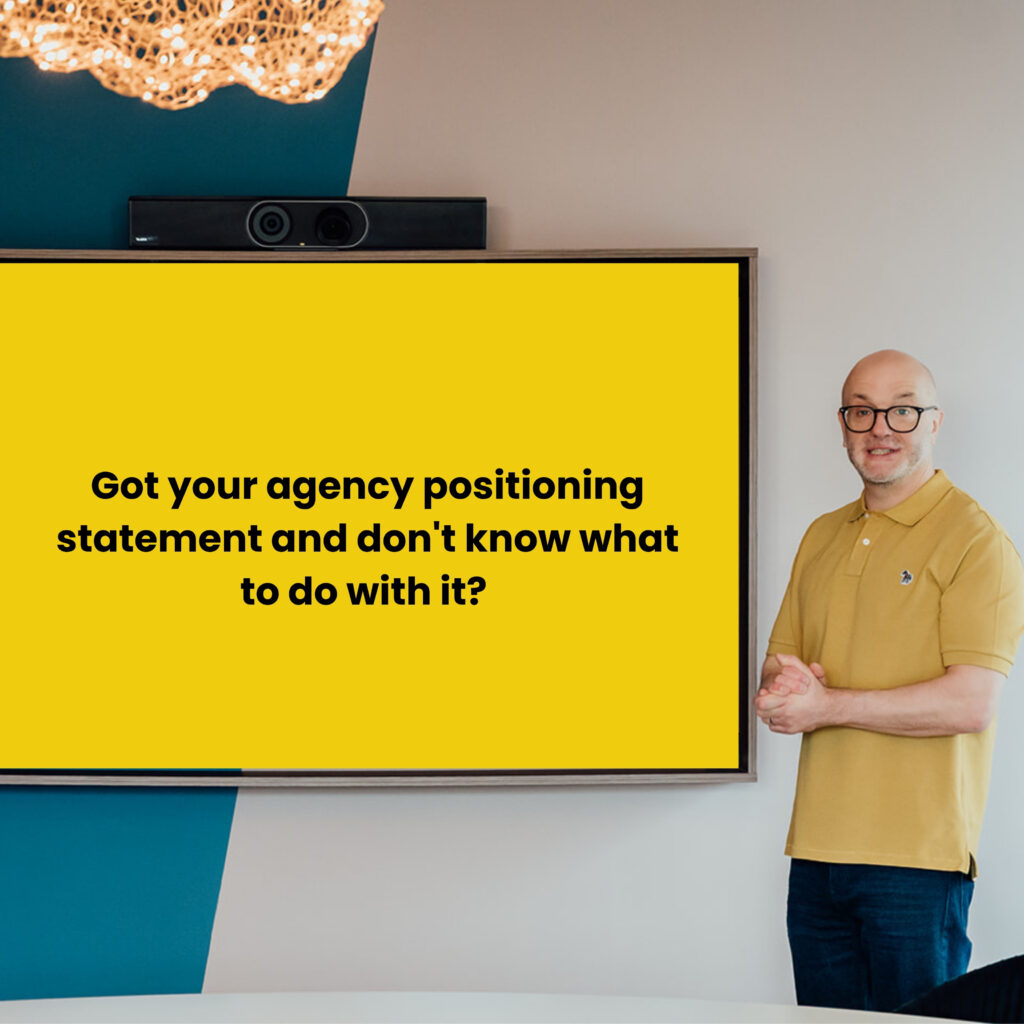
You ran the session. You wrestled with the words. You landed on a sharp positioning statement that finally said who you are and why you matter. It felt like the finish line – and that feeling is exactly the problem.
This post covers why a positioning statement gets filed and forgotten, what the words are genuinely for, the three layers your positioning should travel through, the four decisions it should govern, and a simple test to tell whether yours is working or just decorating your homepage.
Why the Words Feel Like the Finish Line
There’s a moment near the end of every positioning session I’ve ever run where the room goes quiet, someone reads the words back, and everyone nods. It feels like arrival. After hours of circling, you have a sentence that captures the agency. The relief is real.
But that relief is a trap. The clarity you feel at the end of the work is so satisfying that it masquerades as completion. You did the hard part – so the words go up on the website, get dropped into the pitch deck opener, and then quietly stop mattering. The behaviour of the agency doesn’t change at all. The evidence on this is brutal. Research from Up to the Light’s 2026 client study, drawn from 700 client interviews, found that only 8% of clients can accurately recall their agency’s positioning. Worse, 69% believe agency positionings are not consistently evidenced in the agency’s actual approach and work. The words exist. They just don’t live anywhere real. That’s the gap. Most owners treat a positioning statement as a destination – a thing you arrive at. It isn’t. It’s a tool you pick up and use, over and over, to make decisions you would otherwise make badly.
“A slogan is something you say. A filter is something you use. Your positioning statement is the second thing – and most agencies only ever treat it as the first.”
What a Positioning Statement Is Actually For
Here’s the reframe I give every owner who asks me where the words go: your positioning statement is an upstream filter, not a downstream slogan. It sits above everything you do and governs the decisions – it does not sit at the bottom as a tagline you paste onto marketing.
That distinction changes everything. A slogan is something you say. A filter is something you use. The words from your session are only worth the time you spent if they start changing what your agency does, says yes to, and walks away from. When I ran my own agency, the positioning work that mattered wasn’t the work that produced a nice line for the site. It was the work that gave us a reason to turn down a £40k project because it didn’t fit what we’d decided we were for. That’s a positioning statement doing its job – it cost us money in the short term and made us sharper in the long term. So before the words go anywhere near a homepage, the real question is: what decisions do these words now make easier? If the answer is none, you don’t have a positioning statement. You have a sentence.
The Three Layers Your Positioning Should Travel Through
The reason owners freeze when I say “deploy it everywhere” is that they picture pasting the literal sentence onto every surface. Don’t do that. The polished statement is rarely the thing a client actually meets. It’s the source code, and what people encounter are translations of it.
Think of it in three layers. The core is the tight, precise sentence itself – it lives in your strategy document and in your team’s heads, it’s the reference point every other expression is checked against, but it’s almost never the customer-facing copy. The expressions are the homepage headline, the pitch hook, the email opener, the LinkedIn bio, the answer you give at a networking event – each a different wording of the same idea, tuned to its channel: same truth, different clothes. The behaviours are the proof – how you brief, present, scope, and run the relationship – and this is what makes the other two layers believable or exposes them as a sales line. Clients are direct about what they want here. The same research found they value positioning that is simple and easy to understand, written in normal everyday language, and free of arrogance or hyperbole. The literal strategy-room sentence is often too dense or too clever for that. Your job isn’t to broadcast the core sentence – it’s to translate it into expressions clients actually understand, then back it with behaviour.
The Four Decisions Your Positioning Should Govern
This is the part owners find most useful, because it’s concrete. A working positioning statement governs four specific things. If yours touches none of them, it’s decorative.
First, who you say yes and no to – the highest-value use by a distance. Your positioning is a qualification tool: it tells you which leads to chase hard, which to decline, and which clients you’re quietly the wrong fit for. If the words don’t change a single yes or no in the next quarter, they aren’t working.
Second, what evidence you build – your case studies, proof points, and results should be selected and framed to prove the positioning, because clients are openly cynical about a positioning that’s prominent on a homepage but never followed through in the case studies.
Third, how you behave in the room – the positioning should shape how you brief, pitch, respond, and run delivery, not just how you market, and this is where most agencies fail by treating positioning as a marketing output rather than an operating principle.
Fourth, what you say first – only now does it inform the homepage, the deck opener, the intro email. This is the last 20% of the job, not the whole of it. agencies that start with “what goes on the website” end up with a Standstill positioning: visible, polished, and ignored. agencies that start with “what decisions does this change” end up with a STANDOUT one, where the words are felt long before they’re read.
The Bottom Line
There’s a simple test, and you can run it on yourself today. I call it the three-decisions test, and it cuts straight through the comfortable feeling that the words alone are enough. Ask yourself to name three decisions you will make differently in the next month because of your positioning statement: one client or lead you’ll decline, one case study you’ll lead with, one thing on your homepage or in your standard pitch you’ll change. If you can name all three specifically, your positioning is operational. If you can’t, it’s filed away whatever you tell yourself. The deeper signal is consistency over recall – the headline is that 8% recall figure, but the more important finding is that 69% of clients say agency positionings aren’t evidenced in the work. The words themselves are often fine; the failure is in living them. So don’t end your positioning work on the words. End it on the first three decisions the words now demand. Make the deployment the deliverable – because the sentence was never the point.
Frequently Asked Questions
What is an agency positioning statement actually for?
It’s a decision-making filter, not a slogan. Its primary job is to govern who you pursue and decline, what evidence you build, and how you behave with clients – then, last, what you say on your marketing surfaces. If it isn’t changing decisions, it’s just a sentence.
Should my positioning statement go on my homepage word for word?
Usually not. The precise strategy-room sentence is the “core” – your reference point. What goes on the homepage is an “expression” of it: the same idea, reworded in simple, everyday language for that channel. Clients value clarity and honesty over clever phrasing.
Why don’t clients remember our positioning?
Because most agencies state it once on a homepage and never evidence it in their actual work. Research shows only 8% of clients can recall their agency’s positioning, and 69% say it isn’t reflected in the agency’s approach. Recall follows consistency – clients remember positioning they can feel in how you behave.
How do I know if my positioning statement is working?
Run the three-decisions test. Name one lead you’ll decline, one case study you’ll lead with, and one homepage or pitch element you’ll change – all because of the positioning. If you can name all three specifically, it’s operational. If you can’t, it’s decorative.
