
Your agency’s biggest growth problem probably isn’t your pipeline, your pricing, or your team. It’s you. Not your ability or your ambition – the structural fact that your agency has been built around you in a way that makes it impossible to scale without you at the centre of everything. The same qualities that made you successful – your standards, your client relationships, your ability to make the right call quickly – are precisely what created it.
This post covers what founder dependency actually is and why it compounds over time, the Founder Dependency Index – a five-dimension diagnostic framework for measuring exactly how dependent your business is on you, how to read your score and what it means in practice, why dependency is so hard to break even when founders know the problem, and the four sequential moves that take you out of it.
What Founder Dependency Actually Is
Founder dependency is not about how much you work. Some of the most founder-dependent agency owners in the market work relatively few hours – but every one of those hours is load-bearing. Remove them and the business wobbles.
It is a structural condition: the business cannot generate revenue, make decisions, deliver work, manage clients, or apply its expertise without the founder being materially involved. It functions as a personal services practice rather than a company.
The consequences compound over time. Growth is capped by your bandwidth – you can only handle so many clients, so many decisions, so many conversations. The ceiling of the business is the ceiling of your capacity. The business cannot be sold at full value, because buyers pay for recurring revenue, team capability, and systems – not personal goodwill. An agency that depends on its founder is worth a fraction of one that doesn’t.
The most common mistake is thinking that hiring fixes it. Founders hire people to take work off their plate and then continue being the bottleneck because the decisions, the client relationships, and the knowledge haven’t moved anywhere. Hiring adds capacity. Systemisation transfers capability. Those are different things, and only one of them breaks the dependency.
The dependency doesn’t live in your workload. It lives in the architecture of the business.
The Founder Dependency Index
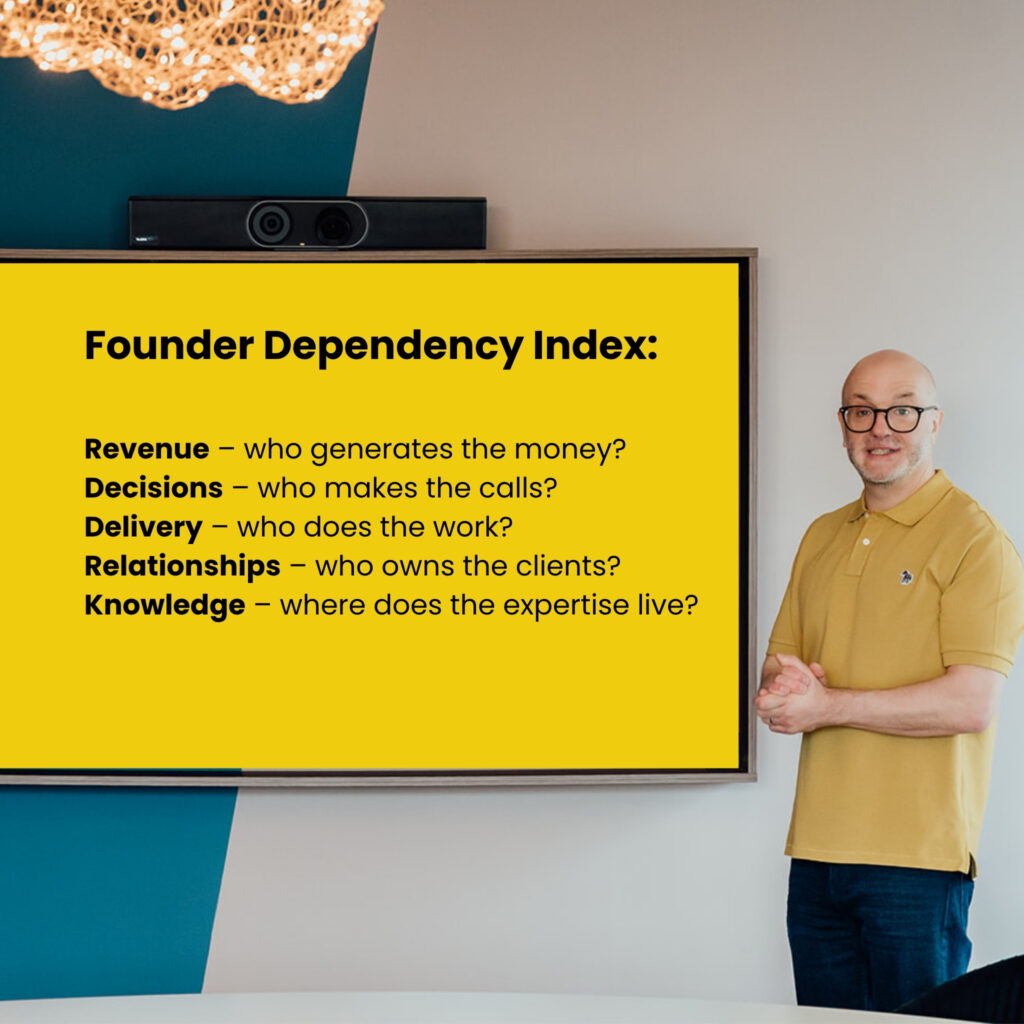
The Founder Dependency Index measures structural dependency across five dimensions. Each dimension runs from Level 1 (fully dependent on the founder) to Level 5 (fully independent). Score yourself honestly across all five, then total the scores.
Revenue – who generates the money? At Level 1, all revenue comes through the founder personally. Every client relationship is yours. Every pitch requires you. At Level 5, new business is owned by a team, a process, and a system – not a person.
Decisions – who makes the calls? At Level 1, every significant decision – commercial, operational, creative – requires the founder. The team escalates everything. At Level 5, the agency has a functioning leadership structure that runs the business. The founder sets direction and reviews performance – they don’t manage it.
Delivery – who does the work clients pay for? At Level 1, clients buy the founder’s personal expertise and expect them involved in delivery. The team supports but doesn’t lead. At Level 5, the agency delivers excellent work consistently without founder involvement. Systems, standards, and senior talent carry it.
Relationships – who owns the clients? At Level 1, clients have a personal relationship with the founder – they call you directly, expect you at every meeting, and would follow you if you left. At Level 5, client relationships are fully institutionalised. The agency could change its founding team without losing clients.
Knowledge – where does the expertise live? At Level 1, critical knowledge – how things work, what clients need, how problems get solved – lives in the founder’s head. None of it is documented. At Level 5, knowledge is fully systemised and transferable. The agency’s capability is independent of any individual, including the founder.
Reading Your Score
Add your five scores together. Maximum possible: 25.
- 5-8: Critical. The business is you. It cannot function, grow, or sell without you.
- 9-12: High. Structural dependency in most areas. Growth is capped by your bandwidth.
- 13-16: Moderate. Progress, but key dependencies remain. One departure or illness breaks things.
- 17-20: Low. The business largely functions without you. Refinement, not rebuilding, is needed.
- 21-25: Minimal. You have built a business, not a job. This is what scalable and saleable looks like.
Most independent agencies score between 8 and 13. The honest ones, anyway. Founders consistently overestimate how independent their business actually is – not through dishonesty, but because dependency is largely invisible when you are inside it.
“The goal is not to make yourself redundant. The goal is to make yourself optional – present because you choose to be, not because the business cannot function without you.”
Why Dependency Is So Hard to Break
Understanding the score is the easy part. The hard part is understanding why so many founders stay stuck even when they know the problem.
The competence trap. You are almost certainly the best person in your agency at the things you do. The most effective at closing clients. The most decisive at resolving problems. The most capable in a client crisis. Every time you step in, the short-term outcome is better than if you hadn’t. The long-term outcome – a team that never learns to function without you – is invisible in the moment.
The identity trap. Many founders built their agency as an extension of their personal brand. The client relationships feel personal. The work feels personal. Stepping back feels like abandonment – both of the clients and of the thing they built. This is an emotional barrier, not a commercial one, but it is no less real for that.
The trust gap. Delegation requires belief that the team can do the job well enough – not perfectly, but well enough. Most founder-dependent agencies have not built that trust, because the team has never been given the opportunity to develop it. Trust and delegation are circular: each one creates the other, but someone has to go first.
The process vacuum. You cannot delegate what only exists in your head. Most founder-dependent agencies have not documented their processes, standards, or decision-making criteria in any meaningful way. Without that documentation, delegation is just hoping – and hope is not a system. Systemisation is the only thing that closes this gap.
The Four Moves Out of Dependency
The dependency trap is not solved in one go. It is solved dimension by dimension, in sequence. Attempting all five simultaneously is the fastest route to nothing changing.
Move 1 – Systemise Knowledge (Dimension 5 first). Before anything else, extract what is in your head and put it into the business. Document the core processes: how you onboard clients, how you run accounts, how you handle problems, what your quality standards actually are. Create playbooks, checklists, decision trees – whatever format the team will actually use. This is the most strategic thing a founder-dependent agency owner can do, because nothing else on this list works without it. Start with the three processes you are most frequently pulled into. Document them in enough detail that someone without your experience could follow them.
Move 2 – Systemise Decisions (Dimension 2). Once knowledge is documented, define what decisions the team can make without you. Be specific – not “operational decisions” but the actual decision types: client budget approvals under £X, scope change responses, staffing allocations, supplier choices. Define the threshold above which things come to you, then enforce it. Every time you override a decision the team should own, you reset the clock on dependency. The management layer will make decisions you wouldn’t have made. Some will be wrong. This is the cost of building a business that doesn’t need you – and it is significantly lower than the cost of never building one.
Move 3 – Systemise Delivery (Dimension 3). Step back from client delivery one account at a time. Pick the account where the risk of stepping back is lowest. Promote a senior lead, give them ownership, and resist the urge to hover. Introduce them formally to the client as the day-to-day lead. Make the transition visible, not gradual and ambiguous. Within 12 months, the founder’s involvement in delivery should be exception, not rule.
Move 4 – Systemise Relationships (Dimension 4). The client relationship is the last and hardest dimension to transfer. Clients who signed with you because of you will resist the transition. Introduce account managers as the primary contact on every client. Shift your role from the relationship to the guarantor of the relationship – visible at key moments, present at strategic reviews, but not the day-to-day point of contact. This takes 6-12 months per client to embed properly. For a portfolio of 10-15 clients, you are looking at a 2-3 year programme of relationship systemisation. Start with the newest clients and the most commercially stable relationships.
Revenue independence (Dimension 1) is the last move, not the first. Get Dimensions 2-5 to Level 3 or above before investing seriously in a sales capability that operates independently of you.
What Separates Standstill Agencies from STANDOUT Agencies
Standstill agencies are dependent. The founder is the business. They are in every client relationship, every significant decision, every delivery sign-off. Knowledge lives in their head. The team escalates rather than acts. The agency cannot function properly when the founder is unavailable – and everyone, including the founder, knows it. They stay stuck in the Critical or High dependency range regardless of how long they have been running.
STANDOUT agencies are systemised. They have documented processes that the team follows without being told. A management layer that makes decisions without the founder in the room. Client relationships that belong to the agency, not the individual. Delivery standards that produce consistent outcomes regardless of who does the work. Knowledge that lives in the business, not in people’s heads. These are the agencies at Level 4 and Level 5 across the Founder Dependency Index – and they are the ones that can grow, scale, and sell.
The gap isn’t talent. It isn’t even effort. It is architecture. STANDOUT agencies have deliberately transferred what the founder knows into how the business operates. Standstill agencies are still running on the model they started with – and wondering why growth always hits the same ceiling.
The clearest test of where you sit is simple: take a real week off. No checking in, no approvals, no crisis management. Brief the team, hand over what needs handing over, and leave. If the business functions normally – clients served, decisions made, work delivered – your systemisation is working. If it wobbles and generates a list of things that needed your input while you were gone, you have a precise picture of exactly where the systems are still missing.
